
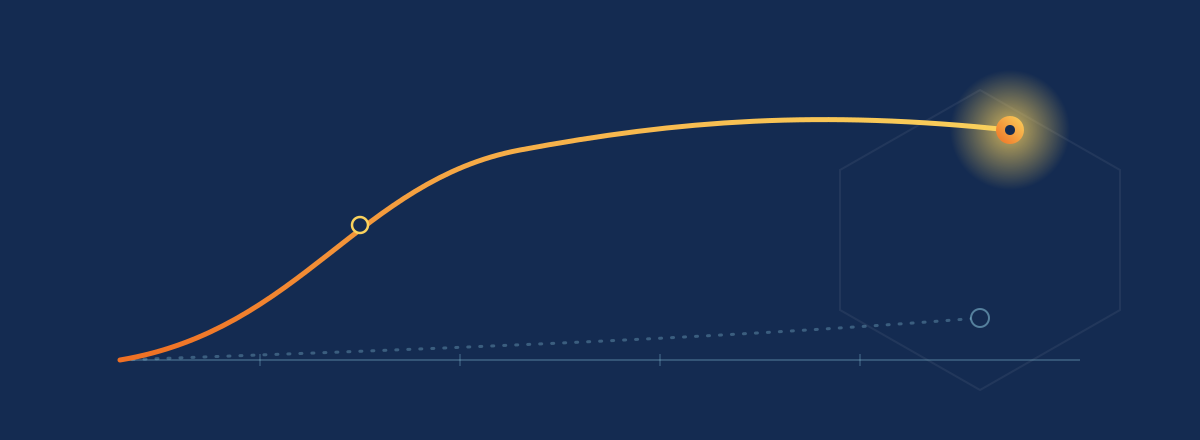
When people describe the rare disease diagnostic odyssey, they focus on its length: the years, the specialists, the dead ends. Those are real costs. But after 25 years commercializing diagnostics, the cost that drives me is a different one. It’s everything we lose, clinically and strategically, while patients wait.
For a growing number of rare diseases, time is treatment. And for the innovators trying to reach those patients, time is also the difference between a therapy that succeeds and one that never gets the chance.
The clinical case is getting hard to ignore
Consider severe combined immunodeficiency (SCID). After newborn screening began identifying affected infants before they got sick, five-year survival rose from 73% to 87% (NIH/NCATS). In spinal muscular atrophy, infants treated earlier consistently do better. The pattern repeats: many of the newest therapies work best before irreversible damage is done. When fewer than 5% of rare diseases have an approved treatment (NORD), the ones that do are exactly where finding patients sooner matters most.
The strategic case runs in parallel
Here’s what the commercial side taught me: a therapy or test only delivers its value if patients are actually identified. Late, scattered diagnosis harms patients, and it also slows trial enrollment, delays adoption, and lets genuinely good innovation stall for lack of a path to the people it’s meant to help. Finding patients earlier accelerates the entire system, from the clinic to the development pipeline.
These two cases, clinical and strategic, point the same direction. That alignment is rare, and it’s worth acting on.
Why we accept the delay anyway
If earlier is so clearly better, why does delay persist? Not from lack of caring. The system is built to be reactive. It waits for a patient to present with a recognizable picture that, in rare disease, may never assemble in one place. We’ve treated that as inevitable. It isn’t.
The shift worth making is from reactive to proactive: systematically searching the data we already have for the patients who fit a profile, and bringing them to a clinician’s attention while there’s still the most to gain. That proactive search is what PathfindEHR™ is built to do. For the patient, that’s not a metric. More and more, it’s the difference in what’s still possible.
— Raymond Tarr, CEO & Founder, Sagacity Diagnostics
Sources
- NIH National Center for Advancing Translational Sciences, Newborn Screening for Rare Immune Disorders Led to Earlier Treatment, Improved Survival.
- National Organization for Rare Disorders (NORD), Rare Disease Facts and Statistics.
This article reflects the author’s perspective and is not medical advice.

Raymond Tarr, CEO & Founder
Sagacity Diagnostics, rare disease clinical decision support. Published April 29, 2026.